Here are examples of structural engineers, geotechnical engineers, or other project team members getting into trouble for either not performing a geotechnical study or for being reckless in their inspections or design. Names of individuals are left out (only initials used) because the point is to learn from these mistakes. Although companies get to deal with the claim or lawsuit, individual PE's also pay a price to the Texas Board of Professional Engineers (TBPE) (their own wallets opened and license suspended) for mistakes, so never flippantly call an engineer "conservative" or "too safe".
2012: An engineer in Azle, Texas, was suspended (license) by the Board for 4 years and fined $4,380 for "failure to practice engineering in a careful and diligent manner." A gabion retaining wall he designed failed and as part of the judgment the Texas Board of Professional Engineers noted he did not perform a geotechnical study ("no geotechnical or soil tests").
2012: S.P. of San Antonio, Texas, had engineering license suspended two years and was fined $2,000 by the Board for certifying (signing off) on incorrect as-built information. A foundation repair plan consisting of 43 drilled piers and 5 footings was certified as completed by the engineer. A partial collapse led to the discovery that only 34 piers and 4 footings were installed. The engineer also had provided a drawing showing the locations of the 34 piers without association to a signed and sealed letter or plan (i.e. it should have been labeled a preliminary drawing at best). The board determined that the engineer's cert was misleading and his actions not careful or diligent, and he issued a drawing without a seal but also without the alternative preliminary designation.
2012: A.G. of San Antonio, Texas, was suspended 2 years and fined $1,500 for issuing a misleading certification letter, allowing foundation construction that was not per city code, and not being careful or diligent in his engineering practice. He certified a foundation repair as-built condition as meeting city code for 14-inch deep pier-footings, but city code requires minimum 24-inch deep footings.
2012: A Structural Engineering firm (Strand Systems) and Builder (Ramer Concrete) were sued by a homeowner for a distressed foundation slab (and home?). The homeowner was able to sue without a Certificate of Merit because the claim apparently was that the Structural Engineer did not perform a "pre-pour" inspection as he was contractually obligated to do so. Lesson: Pre-pour inspections are important and must be thorough (in this case slab thickness was too shallow) and should always be done, especially if you commit to do it in contract language.
2005: C.P. of Spring, Texas, was fined $1,500 for displaying a lack of knowledge of local codes and regulations within the locale of the project, and this lack of knowledge led to multiple submittals and delays for his client.
2005: G.H. of Amarillo, was fined $1,500 and suspended for 1 year for lack of care and diligence in reviewing a plan sheet prior to sealing and signing, and for not including his company title block on the plan sheet. The plan sheet included designs that had nothing to do with him, so he should not have signed it.
2005: K.S. of Lake McQueeney, Texas, was suspended 2 years and fined $3,800 for providing a pre-pour inspection letter (also referred to as a certification letter whether you like it or not) that did not indicate discrepancies that another individual found at the site (rebar size, rebar layout).
2004: T.O. of Austin, Texas, was suspended 3 years and fined $3,000 for an error or omission regarding structural loading calculations which when measured by accepted standards indicated his engineering for this project was not performed in a competent manner. The errors led to concrete columns cracking during construction which led to delays and cost overruns.
2004: J.C. of Plano, Texas, was suspended 2 years and fined $1,850 for falsely certifying that a foundation has been designed in accordance with PTI standards and soil data for conditions at the site. However, it was discovered that the soil data was from a different site, the geotech report referenced in his plans were for a site in a different part of the subdivision (= if you think you can just use geotech soil data from another block in the subdivision you are being reckless).
N.C. of Canyon Lake was fined $500 and formally reprimanded for failing to personally verify drilled shaft depths for piers under a house. N.C. was an expert witness in a case and his statements concerning pier depths were considered misleading.
W.L.P. of Plano, Texas, was fined $4,000 and suspended 2 years for submitting a structural design for a post-tensioned foundation slab for a custom house that ultimately did not perform well. The design was supposedly based on PTI method, but the geotechnical report used for the basis of his design was for a lot several blocks away and performed 19 months earlier. W.L.P. admitted the slab was underdesigned for the actual soil conditions later exposed at his site. To top it all off, W.L.P. had a conflict of interest for being both the Structural Engineer and the partial owner of the concrete company.
M.P. a Structural Engineer in Dallas, Texas, was fined $5,000 and suspended 2 years for providing a foundation slab design based on PTI, but he did not base his design on a site-specific geotechnial report (as required by PTI). His design was deemed misleading and not in keeping with generally accepted engineering standards or procedures. In addition, he signed and sealed the plans for another firm based on what was on the title block, and he had not notified the Board of his association with the other firm (you can list a second firm on your Board profile).
W.S.A. of Austin, Texas, was formally reprimanded and fined $500 for failing to use site specific geotechnical soil study to prepare a residential foundation design. Statements on the plan sheet that the design was based on unconfirmed assumptions about the soil's stability were misleading and not in keeping with generally accepted engineering practices.
W.J.R. of Laredo was fined $500 and ordered to cease and desist from practicing engineering. W.J.R. prepared geotechnical reports that included engineering recommendations for foundation options, but W.J.R. was not a licensed PE. (watch out for geotech letters or reports from non-PE's, this is a reckless violation of state code).
D.L.J. of Kingsbury, Texas was fined $1,250 and formally reprimanded for signing and sealing inspection letters involving inspections performed by coworkers (i.e. technician). The inspections apparently expressed false information concerning type of existing foundation and depth of piers installed. D.L.J. was fined because he did not provide "adequate direct supervision" over his employees, or review the inspection letters adequately, or inspect the site himself.
D.P. of Dallas, Texas, was fined $1,000 and formally reprimanded for affixing his PE seal to structural plans prepared by an employee of his part-time business. Although D.P. had discussions with the employee and directed him to prepare the design, he was not personally present during the employee's performance of the design. D.P. was deemed to have not provided direct supervision over his employee during the performance of the design, which is required in Texas.
M.G. of Friendswood, Texas was fined $2,000 and ordered to cease and desist from using the term "engineer" in any title or marketing literature and from practicing engineering. M.G. identified himself as a "consulting engineer" in a residential inspection report, but M.G. did not have a PE license.
B.D.J. of Rockwall, Texas, was fined $3,000 and suspended 2 years for producing a misleading report and certification, for not conducting his inspection of a residence in a careful and diligent manner, and for actions contrary to generally accepted standards and procedures. B.D.J. was criticized for not keeping appointments with the homeowner and members of the repair crew stated they never saw B.D.J. at the site (failed to perform inspection). The Engineer was also noted to have not performed a slab elevation survey to help justify repair recommendations. The Engineer was also noted to have not realized repair work was going to damage the patio addition but should have provided recommendations to avoid such damage.
J.E.C. of Fort Worth, Texas, was ordered to cease and desist from practicing structural engineering (suspended 5 years). It was alleged that during his testimony as an expert witness in a lawsuit he made statements regarding the effect of pier to beam contact and foundation level tolerances that appeared to be misleading and were not supported by adequate modeling, calculations, or analysis and without fully disclosing the basis and rationale for his opinions.
R.W.P. of Houston was reprimanded for taking 4 months, 8 months, and 9 months to deliver residential inspection reports for 3 sites after an inspection was completed. The reports also contained errors (misleading reports).
N.L.S. of Houston was fined $940 and suspended 9 months for signing/sealing a geotechnical report written by an individual (as another company or legal entity) who was not a PE nor a formal employee or employer of the Engineer. This is deemed aiding and abetting an individual (and company) in the unlicensed practice of engineering.
Sunday, September 23, 2012

Friday, September 21, 2012
Limit of Liability clause can actually work
Terracon was recently sued in federal court by Thrash Commercial Contractors.
Terracon was the testing lab for large fill masses being placed for a Mississippi site and apparently the testing frequency was inadequate and the General Contractor was forced by the Owner (a government agency) to remove the upper 6 feet of fill and re-install, and remove some concrete footings that were already constructed on the fill. A study had been performed to evaluate the fill and the conclusion was that parts of the fill were not properly compacted. Thrash sued Terracon for $300,000 in damages. Of course the Contractor claimed Terracon had poor oversight, and Terracon claimed the Contractor did not properly schedule inspections.
The case ultimately turned to the limit of liability clause in Terracon's contract. The testing lab fee was $14,900, and the limit of liability was $50,000. So Terracon fell back on this position and would not pay the $300,000. The court recognized the following:
(1) Was the contractor free to negotiate for a higher L.O.L.? YES ! Terracon had a statement stating the client could negotiate a higher L.O.L. for an additional fee. The contractor did not negotiate (ask) for such an increase.
(2) Was the amount of the L.O.L. reasonable relative to the fee? For a $14k fee, $50k in liability was deemed reasonable.
(3) Were there any conflicting provisions in the contract? The indemnity clauses protected Terracon from any negligence or omissions by the Contractor.
(4) Did the Terracon contract seek to indemnify even for its own errors? No.
So Contractor had no case on all 4 counts and lost the case for anything more than potentially $50k in damages (not the $300k sought).
I have since reworded our company's contract language :)
Saturday, January 7, 2012
Met Cntr Bldg 10 Failure
A lawsuit concerning Met Center Bldg 10 in Austin, Texas, was settled, with the new owner being paid $1,000,000 by the project team (developer, contractor, structural engineer, and architect) including the geotechnical firm Reed Engineering. Soil movement appears to have caused extensive cosmetic and functional damage to the 350,000 square foot building. An 18-ft deep cut-off wall appears to be the plan to serve as a moisture barrier, in addition to some drainage improvements. Did the contractor or civil/structural plans not follow geotechnical recommendations? Or was the geotechnical report providing reckless or inadequate recommendations?
Saturday, February 19, 2011
Let the states keep their tax dollars and fund state DOTs

Dale Conger, a P.E. in Houston, Texas, wrote a great editorial response to another article by another "can't wait to get federal tax dollars" writer at Civil Engineering magazine. The editorial is provided below.
As I read the special report [...] it struck me how quick we are to defer to the federal government in so many things. As a group representing the nation's infrastructure engineers, we are on record as looking for "increased federal leadership in infrastructure" and a need for a "federal plan" for a "national vision and focus" on "systemwide results."
Shouldn't we be working with our locally elected officials to provide this leadership and vision?
In most instances around our nation, infrastructure is a local issue, and it should be planned, funded, and constructed by state or local government. But over the years we have learned to defer to the federal government as it inserts itself into any and all issues concerning funding. Many local governments now use a lotto mentality toward planning infrastructure funding. The approach is to seek out federal funding and then sit back and wait for it to appear, courtesy of a local congressman. This, of course, does wonders for the re-election of congressmen, but is it really a plan for funding our infrastructure needs? I believe that a case could be made that the decline in infrastructure funding is related to the level of federal involvement.
As many engineers have found in working on federally funded projects and programs, the simple funding of a project is not the goal of federal involvement. These agencies react to the directions of Congress, which is not a body that can have any intimate knowledge of the infrastructure needs of our communities. Congress gives direction to the agencies in general program and policy terms, as well as earmarks. These then become the funding priorities that work to limit the use of desperately needed funds only to targeted projects. As the end of the day, those funds that really did originate from the local area of need are just returned with alot of unneeded and unwanted strings attached.
As just one example, the FHWA breaks its $42 billion federal aid highway budget into 4 broad strategic goals (5 if you count "organizational excellence" which is their term for their overhead budget) and 12 general line-item accounts, yielding 48 budget categories, which of course then have to be allocated to the states and territories. A project has to fit within one of thse budget programs to receive funding. So a project that actually has a higher need than another can go wanting because it does not fit the category in which funds might be available. This is after spending years in a planning and environmental process that hinders so many of our needed infrastructure projects these days. And this agency is only 1 of 14 covered by the DOT.
So do we as a professional society [ASCE] really need to be advocating the expansion of the system? Have we explored what the nation would be like if the FHWA disappeared and all of those highway dollars just stayed within the state DOTs? Now that would make for an interesting article."
Abolish the FHWA's funding function and return all those tax dollars to the states for their DOTs, now that is a great idea. How many tax dollars are lost in the system and lost to federal overhead costs as the feds manage and oversee a re-distribution of this money? I wonder.
Samuel Staley of National Review had this suggestion:
"Federal policy should be defined by constitutional principles and the concept that was the cornerstone of the justification for federal funding of the Interstate Highway System: interstate commerce. Congress should narrow the scope of federal transportation policy priorities to 4 core principles:
1) Fund only projects that have true interstate commerce ramnifications.
2) Fund only projects that have a significant impact on the national transportation system.
3) Enable state and private sector financing for transportation projects to leverage and in some cases substitute for national taxpayer funding.
4) Fund research into safety and technology that is beyond the scope and capability of state DOTs.
Monday, January 4, 2010


Value Engineered Home Depot cracks

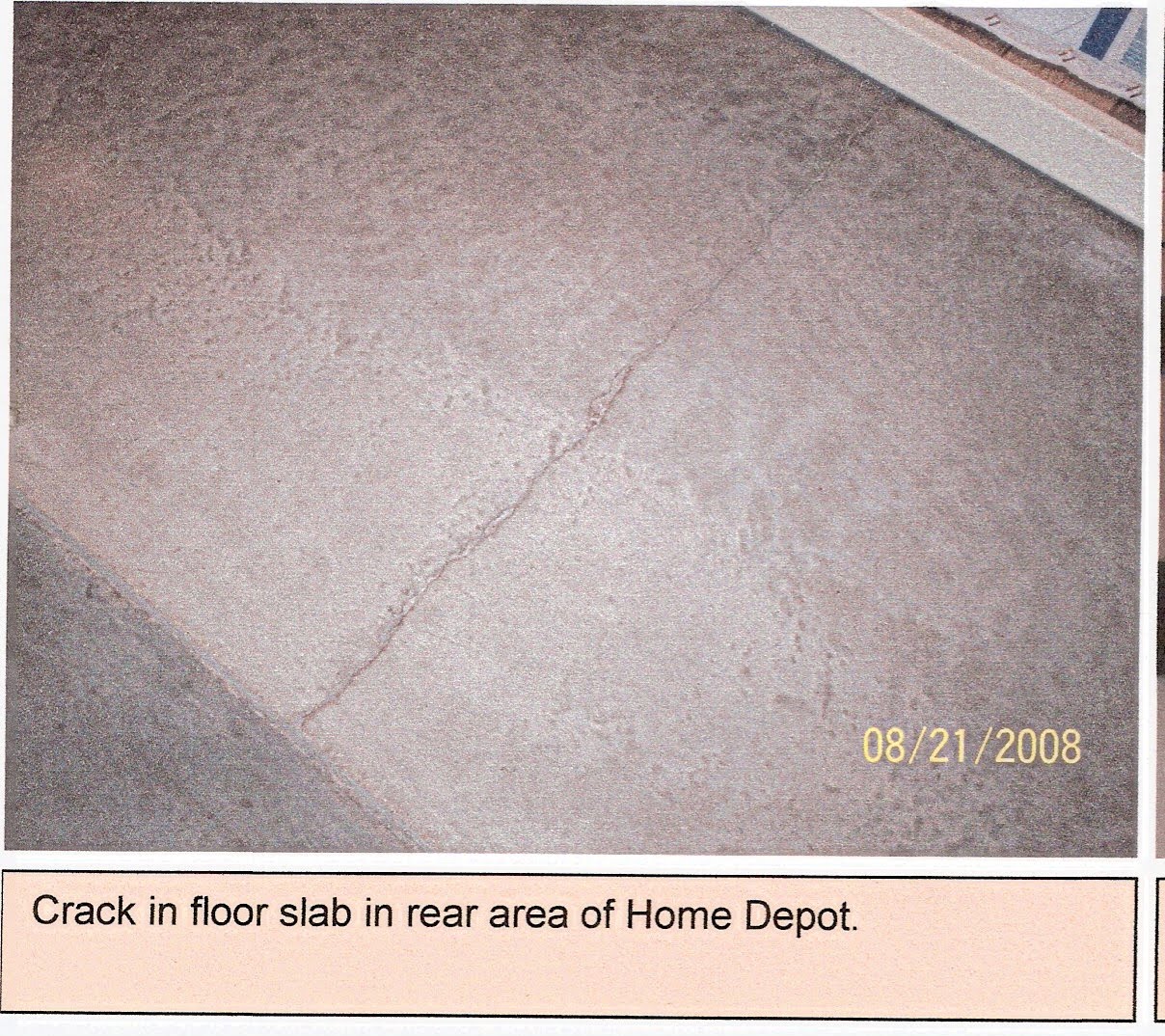
I was the geotechnical engineer of record for the Shops at Arbor walk shopping center (strip center) at Mopac and Braker in Austin, Texas. The center included a pad site for a big box store, in this case Home Depot. Kleinfelder, a competing geotech firm, decided to "value engineer" the Home Depot foundation recs since Home Depot was a national client of theirs. I warned Simon Properties that Home Depot had a low tolerance slab movement spec (i think it is 0.25" per 50 feet) and that the proposed value engineered shallow foundation / limited soil improvement recs could not guarantee meeting that performance spec and that i could not stamp such a recommendation. Simon went with the cheaper alternative of course. Being inquisitive and upset at losing the QC testing portion of the project, i went back a couple of years later to check on the performance. Sure enough, the tall racks in the Home Depot were tilting as evidenced by inspection with a long level, the Home Depot manager on duty complained about uneven floors causing their low-riding equipment or forklifts to get caught scraping the floor or even getting stuck in localized areas, there were some minor cracks in the floor slab, and outside there was a large crack in the concrete pavement in the deep old fill area of the site.
Just another case history proving that "value engineeering" is really neither.



Saturday, October 10, 2009
Ocean Tower Settlement and Implosion


In 2006 construction began on the 31-story condo building known at the "Ocean Tower" . The hi-rise included a 4-level parking garage immediately adjacent and connected to it. In 2008 construction was halted when large cracks were observed in parking garage walls and in beams in the hi-rise.
In July 2008 the developers filed a $125,000,000 lawsuit against Raba-Kistner geotechnical engineers and the structural engineer and the general contractor Zachary Construction. Zachary however was later dismissed from the lawsuit.
Although the facts of the case are not disclosed and difficult to obtain, the lawsuit does reveal that the exploratory borings were no deeper than 100 feet, and the design pile depth was 95 feet in the final construction drawings. I think 401 16-inch diameter auger-cast piles were revealed to be under the hi-rise building footprint. Settlement of the structures was indicated to be 4" to 8" under the garage, and 8" to 16" under the hi-rise, which is catastrophic so the "leaning tower of Padre" is actually a reasonable moniker.
I would love to see the calculations by Raba-Kistner and by the structural engineer to find out the root cause of the flawed design (errors and omissions anyone). I can hypothesize, maybe Raba's engineer(s) thought the piles would be 100% skin friction piles but over-estimated the skin friction developed? Or maybe they did include end bearing capacity but didnt realize that the piles would end up 95 feet deep, just 5 feet above deepest exploration depth? Or maybe Raba did not analyze "group pile" settlement models? I also question the length to diameter ratio, it is pretty slender (95/1.33 = 71). Who knows, right now all i can say is that a geotechnical report for a project of this magnitude is usually written by one engineer and reviewed by another more senior engineer. I don't know whose 2 signatures were on the Raba report, but i would never hire these guys to be geotechs on my projects.
In late 2009 the owner hired Controlled Demolition Inc to start planning the implosion of the building since it was too costly and impractical to try and repair the structure, much less get anyone to move in considering the stigma now associated with the building.
See photos here:
http://texasgeotechnicalengineer.blogspot.com/2010/01/ocean-tower-implosion-photos.html
Subscribe to:
Posts (Atom)