Saturday, March 24, 2018

How often do water supply lines or sanitary sewer lines leak?

As reported by the Austin American Statesman, during the hot drought period in 2011 in Austin, the Austin Water Utility via spokesman Jason Hill reported 55 calls a week average concerning broken (leaking) water lines.  The typical average during summer seasons is 35 to 40.  "A good portion of the ones we are seeing are the small lines from the water mains to the homes."  In 2009 40 to 60 leaks a week were reported in June, July, and August, with a peak of 66 in the last week of August.  In 20111 a high of 103 leaks was reported in the last week of July.  Another figure reported for 2011 was 60 to 80 per week.  October 2011 reported approximately 50 leaks per week.

Texas municipalities reported system leak rates in 2013 and the leak rate varied from 4% system wide loss to as high as almost 18%.  Water mains under residential streets can impact house foundations in the adjacent lots.  Leaks in the feeder lines to homes also contribute to the loss.

Back in the early 21st century when many geotechnical engineers were assisting insurance companies with homeowner's insurance policy claims related to house damage with a suspected cause being soil movement and plumbing leaks, hundreds and hundreds of claims were apparent.  Many of these claims did reveal plumbing leaks.

It is foolish to design site preparation and foundations based on the assumption that either (1) a plumbing leak will not occur, or (2) if a plumbing leak occurs well then the owner is out of luck.  This is ridiculous.  You do not design building foundations based on luck, particularly for a condition with a relatively high probability of occurrence.


Thursday, March 23, 2017

The Leaning Tower of San Francisco

San Francisco, the land of leftist leaning ideology and now a leaning skyscraper.  The Millennium Tower, sarcastically referred to locally as the "Leaning Tower of San Francisco" opened in 2009 but by November 2016 had settled up to 16 inches (based on publicly available reporting) and tilted 2 to 6 inches apparently to the northwest.  New settlement appears to continue, one reference indicating 1 to 2 inches per year.


The building was constructed (apparently) on skin friction piles through an old landfill and presumably into local native soils above bedrock (but not bearing deep to reach bedrock).  The geotechnical report by Treadwell and Rollo (firm acquired and is now a part of Langan Geotechnical) could not be obtained, but obviously there was a geotechnical modeling error that seriously overestimated skin friction capacity or underestimated any negative impacts from pile group settlement, or maybe the structural engineer underestimated dynamic structural loads (i.e. storm wind loading) given to the geotechnical engineer that would be maximum loads on the piles on one side of the building, i am only speculating.
Crack monitors are seen here on a lower level concrete wall.  Distress was also visible in the exterior sidewalks and their joints to the building.


You can research online all the litigation and municipal public policy issues that have arisen due to this fiasco, if you are curious to learn more about this situation.

If you are a Geotechnical Engineer working on a high rise project with recommended foundations supported on soil and not rock, you must, must, seek secondary review and commentary from another Geotechnical Engineer (or two), these projects are too expensive and too exposed publicly to permit any errors.  And in California where earthquakes occur, one has to wonder how this building will perform with piles embedded in saturated soils beyond a certain depth, soils susceptible to liquefaction.  Earthquake engineering is not a part of my purview of expertise so i defer to the California Geotechnical Engineers to figure this one out.

Saturday, August 20, 2016

Subdivision in Hutto Falls Apart Due to Expansive Clay

Andrea Lorenz reported on this case for the Austin-American-Stateman back in 2008:

"The soil that made the town of Hutto a destination for farmers in the 1800s has caused headaches for some of the area's 15,000 or so new suburbanites.

  Homeowners in at least two subdivisions are facing problems so extensive that the builder moved some residents out of their homes for weeks while repairs were made.

City officials say the problems, which might affect all 787 homes in the Hutto Parke neighborhood and several homes in Legends of Hutto, are not serious structural issues. But they have spurred the City Council to consider a more stringent building code.

Some residents say problems are structural, caused by inadequate foundations for the type of soil in Hutto. They say their homes have not been repaired, and they have taken their grievances to the Internet, looking for others in similar straits.

At issue is the black clay that gives the Blackland Prairie region its name. The soil requires extra precautions by builders or homes will shift more than usual. The clay expands and contracts with moisture. If foundations are not designed to handle that movement, the stress can cause cracks, popped nails and separation between walls and ceiling trusses.

Marion Wallace had problems with the house she bought in the Hutto Parke subdivision in 2004. Like most of her neighbors, she agreed to let the builder, Lennar, remedy the problems, which included prefabricated roof trusses attached too tightly to the walls.

"It was the most stressful, harrowing ordeal that I've gone through," Wallace said. "They take your whole house apart and put it back together again."
Last year, the city first heard from homeowners about problems in Hutto Parke and the Lennar-built homes in Legends of Hutto, according to the city's former chief building inspector, Dan McDowell.

The problem stemmed from the nails attaching the roofs to the drywall being too close together, so there was not enough give for the foundation to move without cracking the drywall, according to Kathy Kirtz, Lennar's regional director of customer care.

Kirtz would not say how many homes are affected, but she said the company sent letters to residents of two subdivisions in Hutto explaining the situation.
Kirtz blamed the problems on subcontractors hired by Lennar, but she did not name them.

To fix the homes, workers were reinstalling the drywall, Kirtz said, but after the repairs started last year, the workers discovered a less invasive process. They now make the repairs through the attic, she said, so the residents don't have to move out.

She acknowledged the soil is part of the problem but said the ultimate cause was too little space between the nails attaching the roof to the drywall. "Match that with foundations moving as they should, and that was causing the cracking in the ceiling lines," Kirtz said.

Some homeowners and housing advocates say the repairs aren't enough. One resident, Mike Crump, started a Web site, www.searchhutto.com, where homeowners share horror stories.

Charles Fain, 44, operates a page on YouTube where he posts videos of interviews with Hutto Parke residents and homes still under construction. A former schoolteacher who now works in customer relations at Dell, Fain bought his home in 2004 after seeing a sign for zero down payment on a new home. He has put about $17,000 into his home, he said. The appraisal district last valued the home at $103,000; Fain paid $119,000. He's not sure if it has decreased in value because of what has happened in the neighborhood.

Lennar's Web site prices new homes in Hutto Parke from $137,490 to $161,490.
Fain decided to run for the Hutto City Council in May because he said some members of the council weren't responsive to the Hutto Parke residents' problems. He's running against McDowell, who retired from his staff job to seek a council seat.

City staff members hope the city's new codes, to be developed with public input and council discussion in the next year, will prevent problems. But critics say the city and home builders are being dismissive of the more serious concerns.

Janet Ahmad, president of the San Antonio-based Homeowners for Better Building, said her organization has heard complaints statewide the past three or four years about nails popping out of walls. She said the ones in Hutto Parke are caused by problems in the foundation and extra wall movement, based on her experience working with homeowners.

She says home builders in Texas should be held to stricter codes. In areas with expansive soil, builders should bring in more stable soil on which to put foundations, grade the front and back lawns, and take other measures to make sure foundations are secure.

The dirt below Hutto expands more than that of the rocky land west of Austin, said Mike Risinger, a soil scientist with the state.
The Hutto soil shrinks when dry and swells when wet. If a portion of land below one side of a home gets wet but the other side is dry, Risinger said, the house will shift, and foundation slabs can crack.

The U.S. Department of Agriculture Natural Resources Conservation Service has determined that most of the land in Hutto is made up of the most expansive type of clay. According to the department, the soil is "very limited" for building, with weaknesses that "generally cannot be overcome without major soil reclamation, special design, or expensive installation procedures." The agency recommends several precautions during construction to counteract the soil's weaknesses.

Building plans submitted to the city for Hutto Parke homes stipulated that the foundations be constructed for clay soil with a high movement rate and included instructions such as replacing the clay with a more sturdy filler. Both Lennar and the city said the homes were built according to those plans.
The area around Manor has similar soil, according to soil scientists. The city hasn't had problems with new homes, said development director Tom Bolt. However, the foundations of many homes built in the 1930s and 1940s have had to be replaced.

In Hutto, Fain has been meeting with elected officials to get more help. For most disgruntled homeowners, the process involves filing a complaint or requesting an outside inspection through the Texas Residential Construction Commission.
Twenty-one people in Hutto have complained to the commission in the past three years. Of those, eight complaints were about Lennar Homes, and all eight cases have been resolved or closed.

About 40 Hutto homeowners have hired a law firm in Austin to help them resolve their problems.

Attorneys Amy Welborn and Richard Alexander say no lawsuit has been filed and wouldn't say whether one would be, but they said some things were not revealed to their clients when they purchased their homes.

Several homeowners used government-backed loans to purchase their homes, and in the applications, Lennar indicated the homes were not built on expansive soil, even though the city says they were. Kirtz said marking the wrong box on the loan application was a clerical error.

The federal government investigated five claims in Hutto Parke after prompting by U.S. Rep. John Carter, R-Round Rock, said Patricia A. Campbell, a spokeswoman for the U.S. Department of Housing and Urban Development.
Officials at the Denver Homeownership Center, a HUD agency, concluded that under the home warranties, Lennar is obligated to take care of any defects in two of the homes. In those cases, the government won't be doing anything further, Campbell said in an e-mail.

Two other cases are still under review. One case was dropped.

Eagle Ford Clay Wrecks House in Mansfield

Amid thousands of homes in Texas that suffer damage from expansive clay soils and arguably improper structural and geotechnical design or Builders taking chances, this is just one case history that made it to the Texas Supreme Court.  The following is by Wayne Slater of The Dallas Morning News (2007)....The house was constructed on what appears to be the "Eagle Ford" geologic formation, which frequently contains expansive clay.  The Builder was Perry Homes, who similar to almost every other spec home subdivision builder, resists the expense associated with proper site preparation and foundation design techniques to build homes.

- - - - - - - - - - - - - - - - - - - - - - - - - - - - - - - - - - - - - - - - - - - - - - - - - - - - - - - - - - - - - - - - -
"In the beginning, Bob and Jane Cull thought if they just wrote homebuilder Bob Perry a letter about all the defects in their new Mansfield house, everything could be resolved.

A tortuous legal battle has carried the retirement-age couple through the courts, to arbitration and now through the courts again — all the way to the Texas Supreme Court. The Culls have won every round, but their home has not been fixed, legal costs have soared and the couple has postponed retirement plans.

"You think you can wake up from a nightmare and it'll be over," said Jane Cull, a physicians' liaison. Instead, the couple watches as the home's defective foundation continues to move, some windows won't open and more cracks form in walls, according to engineering reports.

A spokesman for Perry said the case is built around an important principle: whether arbitration or the courts will settle disputes. But the Culls say their case against Perry Homes illustrates how construction disputes can last for years without resolution and how the system is stacked against average homeowners who challenge homebuilders with wealth and political influence.

Particularly this builder: Perry is the nation's most generous individual political donor. He has been a leading advocate of laws to limit court awards against businesses and a financial benefactor to politicians and judges. And he has funded Republican candidates up and down the ballot in Texas, including more than $340,000 to the nine justices that will hear the Culls' case.

Perry Homes spokesman Anthony Holm said the donations are irrelevant.

"All we're trying to do is get our day in court," Holm said.

The Culls filed suit in 2000 to force repair of their house. But they grew concerned a legal battle could take years and went to arbitration instead, thinking it would resolve the issues quicker and with less expense.

Holm said the switch was unfair to Perry Homes, which had spent time and money preparing for a trial. He says the couple waived its right to arbitration.

It is that legal question — "at what point in time does a consumer waive their right to arbitration?" — the high court has been asked to decide, he said. Arguments will be heard in March.

Consumer advocates say Perry has spent millions of dollars creating a political and legal system tilted in his favor.

"It's not surprising that he showered tens of thousands of campaign dollars on the Texas Supreme Court," said Andrew Wheat of Texans for Public Justice, a nonprofit group that tracks campaign contributions.

"What is shocking is that the judges who took all this money have agreed to hear Perry's appeal of a lemon-home case — one that he already lost in front of an arbitrator and two Texas courts," he said. "It's three strikes and you're out in the Texas justice system — unless you own the league."

Wheat's group receives financial contributions from trial lawyers that represent people suing businesses.

Bob Cull is 69, a stout man with round spectacles and suspenders who works as a manager in the health care industry. His wife is 64, petite with white hair, and she carries a briefcase stuffed with documents about the couple's legal odyssey.

When they signed on with Perry Homes in 1996, the Culls thought they were building their dream retirement home, with 2,800 square feet and upgrades such as cedar closets and raised arches, in a new subdivision south of Fort Worth. There was a golf course and a view of the pond.

"I can remember sitting on the property before there was a house on it, watching the sunrise, and thinking, 'Oh my, this is the place,'" Jane Cull said.

"This was going to be our forever, On Golden Pond nest," she added.

But the house was never whole.

"First we thought they'd bought the wrong-sized door," Jane Cull said. "Leaves and critters could come in. Roof supporters were not staying attached in the attic; they were just hanging free. And there were cracks in the walls and the tile was cracking."

The couple complained, but work crews simply patched the problems, they said. Soon, they were sure their new $250,000 home had fundamental defects, and they expected Perry to make it right.

Bob Cull described himself as "a firm believer that people settle their differences face-to-face and resolve things on a kind of man-to-man basis. We thought this was something we could talk to Bob Perry about over a cup of coffee and settle with a handshake."

He wrote to Perry, the first of many letters to come, outlining the problems. Engineering reports, both by the Culls and by the warranty company contracted by Perry Homes, concluded the foundation was defective, he said.

Their house was now valued at perhaps only a third of the original purchase price.

Eventually, the couple got a letter from the attorney for Perry Homes, John Krugh, saying the firm had done all it was going to do. Perry Homes had provided surface drains, patched the walls and sealed gaps in the concrete, but made it clear it bore no more responsibility for the Culls' problems.

In October 2000, the Culls filed suit against Perry Homes. But before the case went to trial, the couple had second thoughts and moved to have the matter decided by an independent arbiter because, now in their 60s, they feared spending their retirement years in a long legal battle.

The homebuilder resisted and both sides went to court. A district judge, the appeals court and the Texas Supreme Court all ruled for the Culls and directed that both sides go to arbitration.

After several days of hearings in 2002, an arbitrator directed Perry Homes to pay the Culls more than $800,000. That includes the cost of the house, punitive damages and legal costs. With interest, the award would now top $1.3 million.

In a lawsuit, discovery rules govern how the two sides must share information. The Culls' attorney says the couple got nothing in discovery it couldn't have gotten in arbitration, but Holm says the Culls got information the company didn't, and that the arbitrator was biased against the homebuilder.

"There appears from our perspective to have been very real bias on behalf of the arbitrator," said Holm. "And there is a real question about when the plaintiff waived their right to arbitration."

A district court rejected those arguments. Perry Homes took the case to the appeals court, which also ruled for the Culls. The homebuilder again appealed to the Texas Supreme Court, which has scheduled a hearing for March.

The attorney for the Culls said he was surprised the high court, which accepts a fraction of the appeals it gets, agreed to take the case.

"I'm certainly concerned there's politics at play," said Dallas attorney Van Shaw. "The law's clear. We're entitled to win and lots of courts have seen it that way. So I can't reach any other conclusion than it's politics."

Holm denied that. He said public disclosure of Perry's contributions to all nine judges makes his legal burden more difficult "because every justice there knows there's some kind of donor relationship."

"I have faith in all the justices and ... the justice system in Texas that things are being decided on the merits," he said.

The court does not explain its reasoning for accepting a case.

[...]

But the toll on them is mounting, and they hope the dispute is nearly over. A favorable ruling would end the matter. But if the high court vacates the arbitration award, it would send the case back to district court for litigation that could take several more years.

In the meantime, Jane Cull said recently, "We can't fix our house. We can't sell our house. The warranty company can't fix or sell the house."

They've kept up the appearance of the home, patching and painting. Some windows won't open. Some doors have to be jerry-rigged to close. Cull worries about how any future shifting might affect gas pipes and electric lines.

"These are the rooms where your grandbabies are taking a nap," she said.

Financially, the couple can't move. Bob Cull, who had planned to be retired by now and faces some health issues, has gone back to work managing a small pharmaceutical business in Arlington. Jane Cull continues to work as a liaison for a physicians' group.

"I'm no legal eagle. I'm just a mother and a grandmother and homeowner who would like to have some freedom from stress and fear over where I'm going to live the rest of my life," said Jane Cull. "When you're in the final phase of your life, that's pretty frightening."

She shrugged. "We're kind of like in homeowner purgatory. And we've been here for 10 years."

 - - - - - - - - - - - - - - - - - - - - - - - - - - - - - - - - - - - - - - - - - - - - - - - - - - - - - - - - - - - - - - - - - -

The Texas Supreme Court sent the case back to District Court.  In 2010 a jury ordered Perry Homes to pay the Culls $51,000,000 (sounds a little bit outrageous).  $7 million was for damages and $41 million was punitive (ouch).  

Abandoned Construction Project due to Sloping Del Rio Clay


Now called the Hope Outdoor Art Gallery, where graffiti "artists" can practice their talents, this site with abandoned concrete slabs and concrete walls and unknown foundation elements was abandoned back in 1985.  This site on Baylor Street in downtown Austin was intended to be office space for high-tech industry professionals.  Instead foundation problems occurred during construction and a dispute between the Developer (Owner) and the General Contractor shut the project down.  The building permit expired in 1987.  The site was purchased by a bank in 1989.  Some demolition of superstructure elements occurred but the at-grade and below-grade elements remain.  This site lies downslope of the "Castle Hill" building (former Texas Military Institute site).  A lawsuit by the Developer was settled out of court and included the Geotechnical Engineer and his firm, Trinity Engineering and Testing Corp (now Kleinfelder) and all other parties on the project team.


Slopes on expansive clay formations are inherently unstable.  I suspect downward slope creep occurred as the project team cut and fill along the slope and applied new surcharge loads.  I do not have any information on the foundation design or as-built foundation data.  The lesson learned is that you develop sloping sites on massive clay soil with extreme caution.


Saturday, August 6, 2016

Do not forget the flatwork


In 2012, less than 2 years after ACC (Austin Community College) opened the new campus in Round Rock, Texas, school officials had to budget $2,000,000 to make repairs associated with expansive clay soils.  Fortunately, most of the problems had to do with the flatwork and not the building.  Too often geotechnical engineers focus attention to the buildings (in this case structurally supported slabs cast on void boxes and constructed on concrete drilled piers) but not enough attention to pavement and flatwork in expansive clay soil environments.

Geotechnical work had been performed by Raba Kistner and architectural detailing by GSC Architects.  Uncertain who were the Structural Engineer and Civil Engineer.

One media source reported that some type of soil improvement was attempted in the flatwork areas (6 feet deep of lime injection possibly?).  However, flatwork (sidewalks) had heaved so severely in some areas that doors could not be opened or closed properly.  Good quality geotechnical reports will address the concern with a structurally supported building slab abutting exterior flatwork.  Sidewalks had to be closed due to tripping hazards.

In 2015 ACC reported that soil movement resulted in surface water (rainwater) entering Building #3000 during heavy rain events.  Heaving and shrinking clay soils will change surface drainage profiles, and both the Geotechnical Engineer and Civil Engineer are responsible for addressing this concern with property owners or developers.

Construction repair bids included one $434,000 proposal to install surface drainage swales, install pedestrian grates over the swale, resurfacing of building flatwork to correct drainage issues, and installation of new stormwater drain along one face of Bldg. 3000.

A photo of sidewalk reconstruction efforts is below.  When you consider the $2,000,000 budget for flatwork and drainage repair, I cannot stress enough how important geotechnical, structural detailing, and civil engineering plan detailing are with regards to flatwork and pavement in expansive clay soil environments.  It starts with the Geotechnical Engineer properly informing the project team of the risks and concerns, and the Civil Engineer and Structural Engineer to formalize final design details.


The purpose of this post is to warn fellow Geotechnical Engineers and Civil Engineers (site grading and drainage) to pay more attention to detail on expansive clay soil environments.  The geotechnical study for this site was probably on the order of $20,000, but omissions of recommendations for dealing with flatwork abutting buildings cost the client $2,000,000 for a $114,000,000 facility.  Ouch.


Saturday, June 1, 2013

COE sues Architectural-Engineering firm for expansive clay damage to utilities

[This case was described in Civil Engineering Magazine in 2013, article written by Michael C. Loulakis.  I have condensed it.]

BPLW Architects and Engineers, Inc. provided the MEP design for two student dorm bldgs at Lackland Air Force Base in San Antonio.  Soon after construction was completed, water leaks occurred that even flooded several rooms.  The US Army Corps of Engineers (COE) repaired the broken pipes and replaced the sanitary sewer pipe system.  The COE billed the MEP firm $7,600,000 for the damages and repair work (negligence or omission claim against the MEP firm).  BPLW appealed to the US Court of Federal Claims.  Heaving clay soils and poor surface drainage design were suspected of having led to the pipe damage and flooding damage.

The "standard of care" requires that the MEP firm consider the geotechnical report ("soils report") when designing underground utilities.  The geotechnical report actually warned that the clay soils at this site could heave 9 inches (i.e. worst case scenario).  The construction contract documents, however, included a mechanical connections section and the MEP firm did abide by the requirements of that section, which apparently included language about tolerating 1 inch of differential movement at horizontal to vertical transitions and possibly 4 inches as the horizontal moves away from a vertical run.  The MEP firm was also accused of producing poor drainage plans (grading and drainage).

The Court determined that the MEP firm's design, as well as its grading plans, failed to comply with the contract and the applicable "standard of care".  But there was also testimony that the GC did not install some of the piping system correctly and that the GC had installed a bent and broken piping component under the slab.  There was uncertainty as to whether the GC had graded the site properly for drainage design (no as-built data).

The Court determined that the COE FAILED TO PROVE CAUSATION.  i.e. the COE did not demonstrate that the design, in contrast to other factors, caused the damage directly.  The COE also did not show that the negligent surface drainage design led to the improper grading and ponding of water.  Poor pipe installation by the GC was the potential intervening cause of damage that allowed the MEP firm to escape this claim.

In addition to failing to prove causation, the COE was also determined by the court to have failed in proving a reasonable damage assessment.  The COE witnesses were not experts and provided insufficient testimony on whether the scope of repair work was reasonable or necessary.  i.e. was that $7,600,000 work all necessary and was that cost reasonable.

The court awarded the COE a small amount of $ for certain modifications it had to make to the MEP's design, but most of the other money was not awarded.  As the prevailing party, the MEP was able to recover money from the COE for legal costs, to make matters worse for the COE.

Lesson learned for geotechs: In cases of negligence claims, the Owner or other suing party has to PROVE CAUSATION.  Even if found having breached the "standard of care", the engineering firm's error has to also be found to have actually directly caused the damage and losses.  If the engineering firm can show that construction errors could have caused soil movement or damage, then causation cannot be linked directly to the design.  Now if the GC performed their duties correctly and installed everything per plans and specs, then your error may indeed be the cause and you simply just need to have your insurance company handle the claim.  Another lesson: geotech should address buried utility construction.  I dont know what was in the geotech report for this site but i am surprised the COE did not sue them for omissions (i.e. lack of recs addressing buried utility construction and connections).  Some will argue the opposite: the less you say, the better.


Sunday, December 2, 2012

Sued for using "dry prep" Atterbergs method

In 2010 a concrete company (and their subconsultant geotechnical firm and construction materials testing lab) was sued by the homeowner.  Their house was exhibiting cracking.  The foundation slab was designed as a post-tensioned slab based on the geotechnical report by Louisiana Testing and Inspection (LTI).  The homeowner chose to sue LTI (via the concrete company that hired them) for failing to identify expansive clay soils and for using the "dry prep" method to perform plasticity lab testing in lieu of the more thorough "wet prep" method.  The wet prep method typically yields a PI a few points higher than the dry prep (i.e. PI=24 instead of 19), which can affect the perception of risk of soil movement as well as the foundation slab design parameter values.

Any lab using the dry prep method can be described as lazy.  I only allow wet prep in my lab.

It turns out that significant stripping and clearing was performed for this lot and subsequent investigation showed some expansive clay was present on the site.  An expert witness geotechnical engineer for the defendant  hypothesized that the Builder filled in a large tree stump and root bulb areas with fat clay, or that the widely spaced borings (1 or 2) simply just missed the zone of expansive clay (most of the site was low PI soils apparently) by pure chance.  The condition was chalked up as an anomalous condition that just did not show up at the drilled (explored) locations (boring logs).  He noted the circular pattern of the swelling condition as validation of the clay backfill theory.  There was no reference to plumbing leak or tests for leaks.

The trial court ruled in favor of the concrete contractor (and LTI) (defendant) because:

- the plaintiff failed to prove that LTI's conduct was the cause-in-fact of the house damage.
- the court found that LTI did not discover the swell potential by pure chance
- the court found that LTI did not improperly report testing.
- the judge found that the plaintiff failed to prove that another design would have been used, and that the swelling would have occurred anyway.

I have a feeling that if i was the expert witness for the homeowner there would have been a better argument for holding the geotech (LTI) responsible (i.e. for poor site characterization and design parameter selection instead of looking at wet prep vs dry prep).  They took the wrong approach by suing based on reported data (lab testing) instead of the overall characterization or design itself, but without more info i cannot really comment intelligently on the case.

The good news for geotechs is the court requires a notable burden on the plaintiff.  The court requires 4 things for a finding of standard negligence:

1. Was the conduct in question a cause-in-fact of the harm that occurred?
2. Did the defendant owe a duty to the plaintiff?
3. Was that duty breached?
4. Was the risk and hard caused within the scope of protection afforded by the duty breached?

LTI got off, but only because the homeowner and their team took a poor approach to this case.  LTI still lost money through the time they had to spend on this case, all for using a dry prep method in the lab.

Sunday, September 23, 2012

Geotechnical study required for all new construction

Here are examples of structural engineers, geotechnical engineers, or other project team members getting into trouble for either not performing a geotechnical study or for being reckless in their inspections or design.  Names of individuals are left out (only initials used) because the point is to learn from these mistakes.  Although companies get to deal with the claim or lawsuit, individual PE's also pay a price to the Texas Board of Professional Engineers (TBPE) (their own wallets opened and license suspended) for mistakes, so never flippantly call an engineer "conservative" or "too safe".

2012: An engineer in Azle, Texas, was suspended (license) by the Board for 4 years and fined $4,380 for "failure to practice engineering in a careful and diligent manner."  A gabion retaining wall he designed failed and as part of the judgment the Texas Board of Professional Engineers noted he did not perform a geotechnical study ("no geotechnical or soil tests").

2012: S.P. of San Antonio, Texas, had engineering license suspended two years and was fined $2,000 by the Board for certifying (signing off) on incorrect as-built information.  A foundation repair plan consisting of 43 drilled piers and 5 footings was certified as completed by the engineer.  A partial collapse led to the discovery that only 34 piers and 4 footings were installed.  The engineer also had provided a drawing showing the locations of the 34 piers without association to a signed and sealed letter or plan (i.e. it should have been labeled a preliminary drawing at best).  The board determined that the engineer's cert was misleading and his actions not careful or diligent, and he issued a drawing without a seal but also without the alternative preliminary designation.

2012: A.G. of San Antonio, Texas, was suspended 2 years and fined $1,500 for issuing a misleading certification letter, allowing foundation construction that was not per city code, and not being careful or diligent in his engineering practice.  He certified a foundation repair as-built condition as meeting city code for 14-inch deep pier-footings, but city code requires minimum 24-inch deep footings.

2012: A Structural Engineering firm (Strand Systems) and Builder (Ramer Concrete) were sued by a homeowner for a distressed foundation slab (and home?).  The homeowner was able to sue without a Certificate of Merit because the claim apparently was that the Structural Engineer did not perform a "pre-pour" inspection as he was contractually obligated to do so.  Lesson: Pre-pour inspections are important and must be thorough (in this case slab thickness was too shallow) and should always be done, especially if you commit to do it in contract language.

2005: C.P. of Spring, Texas, was fined $1,500 for displaying a lack of knowledge of local codes and regulations within the locale of the project, and this lack of knowledge led to multiple submittals and delays for his client.

2005: G.H. of Amarillo, was fined $1,500 and suspended for 1 year for lack of care and diligence in reviewing a plan sheet prior to sealing and signing, and for not including his company title block on the plan sheet.  The plan sheet included designs that had nothing to do with him, so he should not have signed it.

2005: K.S. of Lake McQueeney, Texas, was suspended 2 years and fined $3,800 for providing a pre-pour inspection letter (also referred to as a certification letter whether you like it or not) that did not indicate discrepancies that another individual found at the site (rebar size, rebar layout).

2004: T.O. of Austin, Texas, was suspended 3 years and fined $3,000 for an error or omission regarding structural loading calculations which when measured by accepted standards indicated his engineering for this project was not performed in a competent manner.  The errors led to concrete columns cracking during construction which led to delays and cost overruns.

2004: J.C. of Plano, Texas, was suspended 2 years and fined $1,850 for falsely certifying that a foundation has been designed in accordance with PTI standards and soil data for conditions at the site.  However, it was discovered that the soil data was from a different site, the geotech report referenced in his plans were for a site in a different part of the subdivision (= if you think you can just use geotech soil data from another block in the subdivision you are being reckless).

N.C. of Canyon Lake was fined $500 and formally reprimanded for failing to personally verify drilled shaft depths for piers under a house.  N.C. was an expert witness in a case and his statements concerning pier depths were considered misleading.

W.L.P. of Plano, Texas, was fined $4,000 and suspended 2 years for submitting a structural design for a post-tensioned foundation slab for a custom house that ultimately did not perform well.  The design was supposedly based on PTI method, but the geotechnical report used for the basis of his design was for a lot several blocks away and performed 19 months earlier.  W.L.P. admitted the slab was underdesigned for the actual soil conditions later exposed at his site.  To top it all off, W.L.P. had a conflict of interest for being both the Structural Engineer and the partial owner of the concrete company.

M.P. a Structural Engineer in Dallas, Texas, was fined $5,000 and suspended 2 years for providing a foundation slab design based on PTI, but he did not base his design on a site-specific geotechnial report (as required by PTI).  His design was deemed misleading and not in keeping with generally accepted engineering standards or procedures.  In addition, he signed and sealed the plans for another firm based on what was on the title block, and he had not notified the Board of his association with the other firm (you can list a second firm on your Board profile).

W.S.A. of Austin, Texas, was formally reprimanded and fined $500 for failing to use site specific geotechnical soil study to prepare a residential foundation design.  Statements on the plan sheet that the design was based on unconfirmed assumptions about the soil's stability were misleading and not in keeping with generally accepted engineering practices.

W.J.R. of Laredo was fined $500 and ordered to cease and desist from practicing engineering.  W.J.R. prepared geotechnical reports that included engineering recommendations for foundation options, but W.J.R. was not a licensed PE.  (watch out for geotech letters or reports from non-PE's, this is a reckless violation of state code).

D.L.J. of Kingsbury, Texas was fined $1,250 and formally reprimanded for signing and sealing inspection letters involving inspections performed by coworkers (i.e. technician).  The inspections apparently expressed false information concerning type of existing foundation and depth of piers installed.  D.L.J. was fined because he did not provide "adequate direct supervision" over his employees, or review the inspection letters adequately, or inspect the site himself.

D.P. of Dallas, Texas, was fined $1,000 and formally reprimanded for affixing his PE seal to structural plans prepared by an employee of his part-time business.  Although D.P. had discussions with the employee and directed him to prepare the design, he was not personally present during the employee's performance of the design.  D.P. was deemed to have not provided direct supervision over his employee during the performance of the design, which is required in Texas.

M.G. of Friendswood, Texas was fined $2,000 and ordered to cease and desist from using the term "engineer" in any title or marketing literature and from practicing engineering.  M.G. identified himself as a "consulting engineer" in a residential inspection report, but M.G. did not have a PE license.

B.D.J. of Rockwall, Texas, was fined $3,000 and suspended 2 years for producing a misleading report and certification, for not conducting his inspection of a residence in a careful and diligent manner, and for actions contrary to generally accepted standards and procedures.  B.D.J. was criticized for not keeping appointments with the homeowner and members of the repair crew stated they never saw B.D.J. at the site (failed to perform inspection).  The Engineer was also noted to have not performed a slab elevation survey to help justify repair recommendations.  The Engineer was also noted to have not realized repair work was going to damage the patio addition but should have provided recommendations to avoid such damage.

J.E.C. of Fort Worth, Texas, was ordered to cease and desist from practicing structural engineering (suspended 5 years).  It was alleged that during his testimony as an expert witness in a lawsuit he made statements regarding the effect of pier to beam contact and foundation level tolerances that appeared to be misleading and were not supported by adequate modeling, calculations, or analysis and without fully disclosing the basis and rationale for his opinions.

R.W.P. of Houston was reprimanded for taking 4 months, 8 months, and 9 months to deliver residential inspection reports for 3 sites after an inspection was completed.  The reports also contained errors (misleading reports).

N.L.S. of Houston was fined $940 and suspended 9 months for signing/sealing a geotechnical report written by an individual (as another company or legal entity) who was not a PE nor a formal employee or employer of the Engineer.  This is deemed aiding and abetting an individual (and company) in the unlicensed practice of engineering.


Friday, September 21, 2012

Limit of Liability clause can actually work

Terracon was recently sued in federal court by Thrash Commercial Contractors.

Terracon was the testing lab for large fill masses being placed for a Mississippi site and apparently the testing frequency was inadequate and the General Contractor was forced by the Owner (a government agency) to remove the upper 6 feet of fill and re-install, and remove some concrete footings that were already constructed on the fill.  A study had been performed to evaluate the fill and the conclusion was that parts of the fill were not properly compacted.  Thrash sued Terracon for $300,000 in damages.  Of course the Contractor claimed Terracon had poor oversight, and Terracon claimed the Contractor did not properly schedule inspections.

The case ultimately turned to the limit of liability clause in Terracon's contract.  The testing lab fee was $14,900, and the limit of liability was $50,000.  So Terracon fell back on this position and would not pay the $300,000.  The court recognized the following:

(1) Was the contractor free to negotiate for a higher L.O.L.?  YES !  Terracon had a statement stating the client could negotiate a higher L.O.L. for an additional fee.  The contractor did not negotiate (ask) for such an increase.

(2) Was the amount of the L.O.L. reasonable relative to the fee?  For a $14k fee, $50k in liability was deemed reasonable.

(3) Were there any conflicting provisions in the contract?  The indemnity clauses protected Terracon from any negligence or omissions by the Contractor.

(4) Did the Terracon contract seek to indemnify even for its own errors?  No.

So Contractor had no case on all 4 counts and lost the case for anything more than potentially $50k in damages (not the $300k sought).

I have since reworded our company's contract language :)

Saturday, January 7, 2012

Met Cntr Bldg 10 Failure

A lawsuit concerning Met Center Bldg 10 in Austin, Texas, was settled, with the new owner being paid $1,000,000 by the project team (developer, contractor, structural engineer, and architect) including the geotechnical firm Reed Engineering. Soil movement appears to have caused extensive cosmetic and functional damage to the 350,000 square foot building. An 18-ft deep cut-off wall appears to be the plan to serve as a moisture barrier, in addition to some drainage improvements.  Did the contractor or civil/structural plans not follow geotechnical recommendations?  Or was the geotechnical report providing reckless or inadequate recommendations?

Saturday, February 19, 2011

Let the states keep their tax dollars and fund state DOTs


Dale Conger, a P.E. in Houston, Texas, wrote a great editorial response to another article by another "can't wait to get federal tax dollars" writer at Civil Engineering magazine. The editorial is provided below.


As I read the special report [...] it struck me how quick we are to defer to the federal government in so many things. As a group representing the nation's infrastructure engineers, we are on record as looking for "increased federal leadership in infrastructure" and a need for a "federal plan" for a "national vision and focus" on "systemwide results."


Shouldn't we be working with our locally elected officials to provide this leadership and vision?


In most instances around our nation, infrastructure is a local issue, and it should be planned, funded, and constructed by state or local government. But over the years we have learned to defer to the federal government as it inserts itself into any and all issues concerning funding. Many local governments now use a lotto mentality toward planning infrastructure funding. The approach is to seek out federal funding and then sit back and wait for it to appear, courtesy of a local congressman. This, of course, does wonders for the re-election of congressmen, but is it really a plan for funding our infrastructure needs? I believe that a case could be made that the decline in infrastructure funding is related to the level of federal involvement.


As many engineers have found in working on federally funded projects and programs, the simple funding of a project is not the goal of federal involvement. These agencies react to the directions of Congress, which is not a body that can have any intimate knowledge of the infrastructure needs of our communities. Congress gives direction to the agencies in general program and policy terms, as well as earmarks. These then become the funding priorities that work to limit the use of desperately needed funds only to targeted projects. As the end of the day, those funds that really did originate from the local area of need are just returned with alot of unneeded and unwanted strings attached.


As just one example, the FHWA breaks its $42 billion federal aid highway budget into 4 broad strategic goals (5 if you count "organizational excellence" which is their term for their overhead budget) and 12 general line-item accounts, yielding 48 budget categories, which of course then have to be allocated to the states and territories. A project has to fit within one of thse budget programs to receive funding. So a project that actually has a higher need than another can go wanting because it does not fit the category in which funds might be available. This is after spending years in a planning and environmental process that hinders so many of our needed infrastructure projects these days. And this agency is only 1 of 14 covered by the DOT.


So do we as a professional society [ASCE] really need to be advocating the expansion of the system? Have we explored what the nation would be like if the FHWA disappeared and all of those highway dollars just stayed within the state DOTs? Now that would make for an interesting article."


Abolish the FHWA's funding function and return all those tax dollars to the states for their DOTs, now that is a great idea. How many tax dollars are lost in the system and lost to federal overhead costs as the feds manage and oversee a re-distribution of this money? I wonder.

Samuel Staley of National Review had this suggestion:

"Federal policy should be defined by constitutional principles and the concept that was the cornerstone of the justification for federal funding of the Interstate Highway System: interstate commerce. Congress should narrow the scope of federal transportation policy priorities to 4 core principles:

1) Fund only projects that have true interstate commerce ramnifications.
2) Fund only projects that have a significant impact on the national transportation system.
3) Enable state and private sector financing for transportation projects to leverage and in some cases substitute for national taxpayer funding.
4) Fund research into safety and technology that is beyond the scope and capability of state DOTs.

Monday, January 4, 2010

Ocean Tower Implosion Photos


The severely settling Ocean Tower condo building in Texas was finally demolished.  Another failure by Raba-Kistner (will need to be more careful with their geotechnical engineering performance in the future).


Value Engineered Home Depot cracks


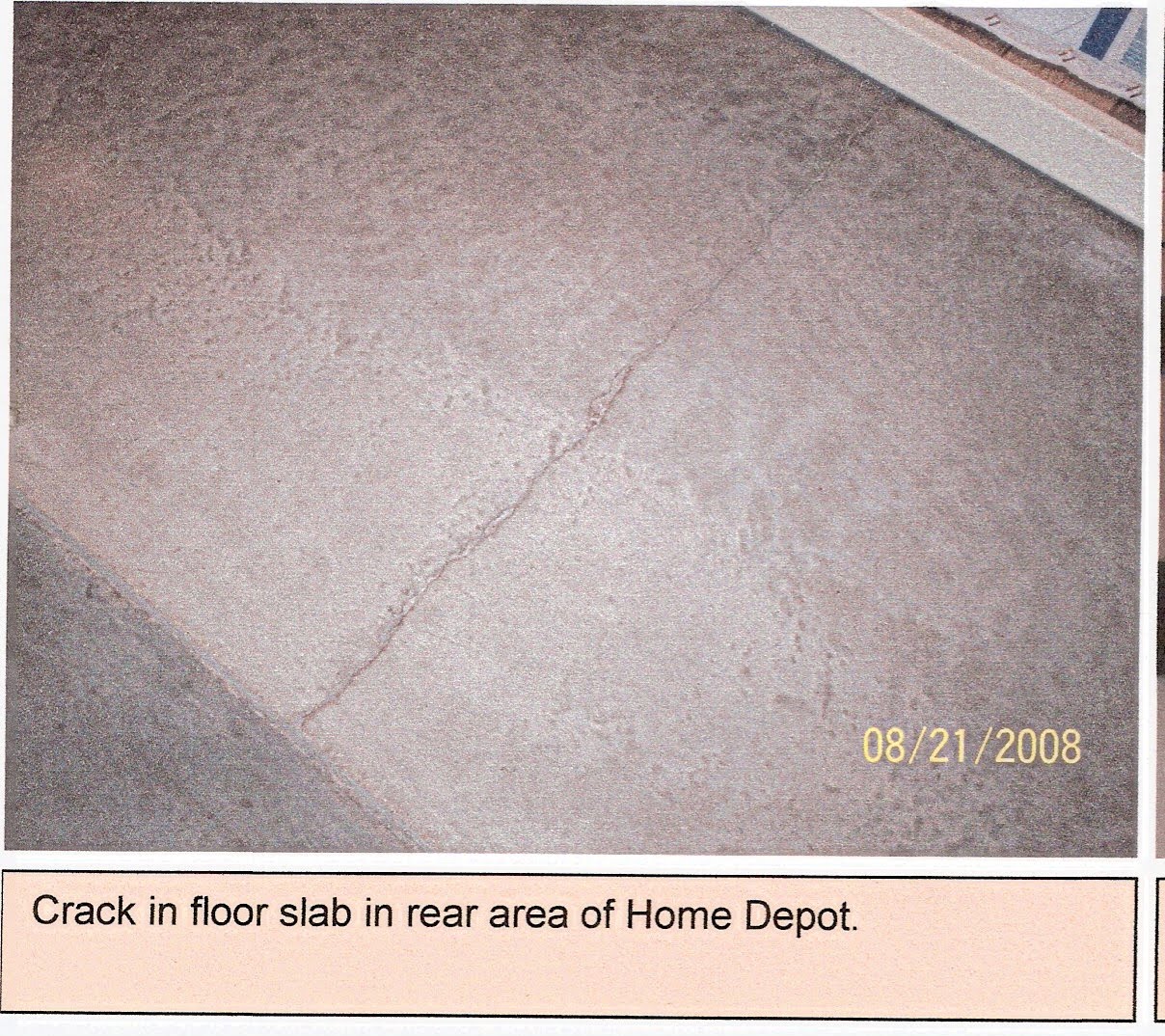
I was the geotechnical engineer of record for the Shops at Arbor walk shopping center (strip center) at Mopac and Braker in Austin, Texas. The center included a pad site for a big box store, in this case Home Depot. Kleinfelder, a competing geotech firm, decided to "value engineer" the Home Depot foundation recs since Home Depot was a national client of theirs. I warned Simon Properties that Home Depot had a low tolerance slab movement spec (i think it is 0.25" per 50 feet) and that the proposed value engineered shallow foundation / limited soil improvement recs could not guarantee meeting that performance spec and that i could not stamp such a recommendation. Simon went with the cheaper alternative of course. Being inquisitive and upset at losing the QC testing portion of the project, i went back a couple of years later to check on the performance. Sure enough, the tall racks in the Home Depot were tilting as evidenced by inspection with a long level, the Home Depot manager on duty complained about uneven floors causing their low-riding equipment or forklifts to get caught scraping the floor or even getting stuck in localized areas, there were some minor cracks in the floor slab, and outside there was a large crack in the concrete pavement in the deep old fill area of the site.

Just another case history proving that "value engineeering" is really neither.


Saturday, October 10, 2009

Ocean Tower Settlement and Implosion


In 2006 construction began on the 31-story condo building known at the "Ocean Tower" . The hi-rise included a 4-level parking garage immediately adjacent and connected to it. In 2008 construction was halted when large cracks were observed in parking garage walls and in beams in the hi-rise.

In July 2008 the developers filed a $125,000,000 lawsuit against Raba-Kistner geotechnical engineers and the structural engineer and the general contractor Zachary Construction. Zachary however was later dismissed from the lawsuit.

Although the facts of the case are not disclosed and difficult to obtain, the lawsuit does reveal that the exploratory borings were no deeper than 100 feet, and the design pile depth was 95 feet in the final construction drawings. I think 401 16-inch diameter auger-cast piles were revealed to be under the hi-rise building footprint. Settlement of the structures was indicated to be 4" to 8" under the garage, and 8" to 16" under the hi-rise, which is catastrophic so the "leaning tower of Padre" is actually a reasonable moniker.

I would love to see the calculations by Raba-Kistner and by the structural engineer to find out the root cause of the flawed design (errors and omissions anyone). I can hypothesize, maybe Raba's engineer(s) thought the piles would be 100% skin friction piles but over-estimated the skin friction developed? Or maybe they did include end bearing capacity but didnt realize that the piles would end up 95 feet deep, just 5 feet above deepest exploration depth? Or maybe Raba did not analyze "group pile" settlement models? I also question the length to diameter ratio, it is pretty slender (95/1.33 = 71). Who knows, right now all i can say is that a geotechnical report for a project of this magnitude is usually written by one engineer and reviewed by another more senior engineer. I don't know whose 2 signatures were on the Raba report, but i would never hire these guys to be geotechs on my projects.

In late 2009 the owner hired Controlled Demolition Inc to start planning the implosion of the building since it was too costly and impractical to try and repair the structure, much less get anyone to move in considering the stigma now associated with the building.

See photos here:
http://texasgeotechnicalengineer.blogspot.com/2010/01/ocean-tower-implosion-photos.html